02 April 2012

Cash Transfers in Africa

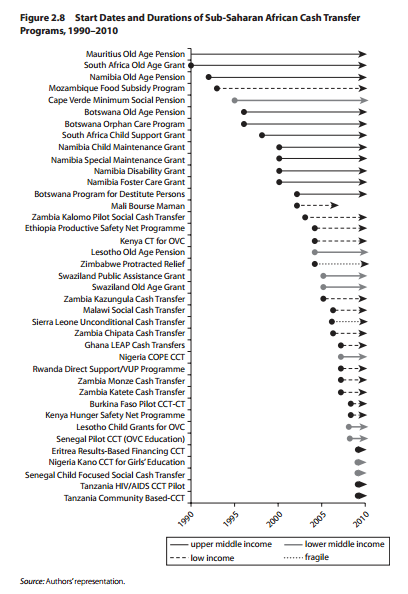
The World Bank has a new book out reviewing the state of cash transfer programs in Africa, which gives a nice high-level overview, and lots of juicy detail on targeting, coverage, and transfer mechanisms, 

including a timeline ... 

... the cost of programs (they get easier to fund as countries become wealthier) ...


... admin costs are a relatively fixed cost - they become a shrinking share of the program budget as coverage increases ...


... and as a sensible response to the limited capacity of the poorest countries to fund their own programs, donors play a key role in funding systems in the poorest countries ...


Yes all I did was skim the report for the prettiest charts. What!

Evidence on moral hazard / fungibility of aid

I'm not sure if moral hazard is really the right term, but in any case, when we give aid we worry about what effect the transfer will have on the behaviour of the recipient - will they just become lazy and wait for more transfers - or make a health  and education transfer "fungible" by reducing their own initial health and education spend in order to buy more booze. Turns out there is some evidence on household response to schools providing more supplies. 

Das, Dercon, Habyarimana, Krishnan, Muralidharan, & Sundararaman find that an unexpected injection of spending at schools in Zambia and India does increase test scores that year. But the following year parents anticipate the additional spending by the school, and decide to reduce their own education spending so that they have more money for other things. And test scores go right back to where they were before.

The researchers offer a couple of potential solutions to this problem 
1 - just increase the size of the grant such that it is larger than household's own education spending - if you increase per student spend by $20 and households only spent $10 themselves to begin with, they can cut all of their spending and you still get a net increase. 

2 - focus additional spending on things that households don't directly fund themselves anyway - "public" goods like teachers rather than "private" goods like books and stationary - so they can't easily substitute away their own spending. Which in a weird way reminds me of Dan Ariely's holiday gift giving advice 
A paternalistic gift ignores the preferences of the person getting the gift, which tends to drive economists crazy, but it may actually change those preferences for the better.

30 March 2012

Yawn.... more RCT debates

Two very smart folks, Mark Rozenzweig and Martin Ravallion have reviews of Poor Economics in the latest Journal of Economic Literature (thanks to Abhi and Andrea for the papers). Obviously self-recommending when smart economists review smart economists. But there does seem to be a bit of a rehashing.

Martin's biggest score is the "where the hell is China?" line. Some of the other criticisms are a bit weaker.
Another likely bias in the learning process is that J-PAL’s researchers have evidently worked far more with nongovernmental organizations (NGOs) than governments.
Which is a bit of a cheap shot, and a bit innacurrate. Researchers have worked with whoever will let them experiment, which yes initially was NGOs but is increasingly governments - see Peru's Quipu commission, Chile's Compass commission, the teaching assistant initiative in Ghana, working with the planning Ministry in South Africa, experimenting with police service reform in Rajasthan, even Britain's Behavioural Insights Unit.

Then
how confident can we really be that poor people all over the world will radically change their health-seeking behaviors with a modest subsidy, based on an experiment in one town in Rajasthan, which establishes that lower prices for vaccination result in higher demand?
Ummmm... well thats why J-PALs policy recommendation for health pricing is based on 6 different studies....


Mark scores his biggest hit in the final footnote on the last page of his article;
Also absent is a discussion of the standard but major problem in the implementation of any programs or transfers targeted to the poor and that do not really spur development—moral hazard.
"Moral hazard" works at both the individual and national government level. If you get aid, you are probably less likely to work hard. The critical question is the magnitude of this effect. I think that on balance the positive value of effective aid outweighs the moral hazard, but that is more of a feeling than an evidence-based proposition. This is also one of the key points made by aid critics Bauer/Easterly/Moyo. Not necessarily that aid doesn't work, as Banerjee/Duflo would like to present their argument, but that even if aid does work, the negative moral hazard effect might outweigh the positive. I haven't seen this argument really addressed at all.

The other serious and neglected criticism for me is on general equilibrium, raised by Daron Acemoglu in the Journal of Economic Perspectives. What if you measure a positive impact of a program on earnings, but those are coming at the expense of others? A training program that increases earnings might just be equipping some individuals to out-compete others in the market, rather than necessarily increasing aggregate productivity, in which case scaling the program ain't gonna work.

So maybe I've missed them - but has anyone seen a convincing rebuttal to the moral hazard and general equilibrium critiques of micro aid project impact evaluation?

-----

Update: A couple of things I missed in my haste - Abhi points out that Rosenzweig makes good points on the sometimes tiny effect sizes lauded in Poor Economics (e.g. where "15% increase" translates to something like 2 weeks schooling or 50 cents), and that RCTs can focus our attention away from the big (important?) questions, but I felt this criticism is pretty well rehearsed.

Update 2: Also Ravallion loses points for his cliched title: "Fighting Poverty One Experiment at a Time". "x one y at a time" is a boring, tired, tired, catchphrase.

Update 3: Ravallion gains points for coining "regressionistas." 
29 March 2012

Maasai Land


Last week I was mostly in Kajiado County. Maasai-land. The County is apparently the third richest in Kenya (by the KIHBS, but this number is disputed), though this wealth is driven by "outsiders" building new developments along the recently completed tarmac road to Nairobi. It can now take as little as an hour from Kajiado Central. The Maasai struggle to compete in the new economy, with limited education and skills.

I spoke to an educated professional (middle class?) Maasai who expressed his dismay at the erosion of the traditional Maasai way of life, as the government's land privatisation policy had led to the parcelling off of land, obstructing traditional migratory herding practices based on traditional beliefs that land is communally owned.

I sat there wondering how I could register some disagreement without sounding like a dick, and how this place epitomised the tension between modernisation and traditional ways of living, transported back to a development studies classroom of tedious debates on "what really is development?" I couldn't help but think that perhaps it was a little hypocritical for this well-educated man to sit in comfortable surroundings and talk about how tough it is for his people to have to give up their cattle herding.

Ultimately, for the Kenyan government to be able to afford to provide better health and education services for its people, it is going to need the revenues that come from the kind of economic development that comes with urbanisation and modernisation.

But this process is disruptive, and the best solution for the "losers" is not to put the brakes on development, but to provide compensation, safety nets, services, and the skills that they will need to engage in the growing economy.

27 March 2012

Assistant Consultant Job at Oxford Policy Management

There a few days left to apply for the Assistant Consultant vacancy at Oxford Policy Management in the "cross-cutting" team that I am part of. I can honestly say that it's a really fantastic place to work with lots of smart interesting people (including tons of ODI Fellows) doing all sorts of smart interesting work. From the job ad:
Oxford Policy Management (OPM) is a leading development consultancy with offices in Oxford, Islamabad, Delhi, Pretoria, Dhaka and Jakarta. We provide rigorous analysis, policy advice, management and training services to governments, international aid agencies and other public sector and non-government organisations. OPM aims to contribute in innovative ways to enhance economic and social progress in developing and transition economies, with a focus on the needs of the poorest people. We have worked in over 90 low and middle income countries over the last 30 years. 
OPM is seeking to recruit an Assistant Consultant to work in its cross-cutting portfolio. The cross-cutting team is OPM's entry point for talented and passionate individuals with limited experience or no particular specialisation to work in development consultancy, and progress by either specialising in one of the other technical areas or remaining generalist. Skills are learnt through project work with senior consultants (including overseas fieldwork and ministry work as possible), a year-round training programme, and mentorship from an experienced senior consultant. We expect high performance, and reward it with promotions, salary increments and responsibility. The cross-cutting portfolio currently contains four assistant consultants and four consultants who work on and sometimes lead consulting and research projects across the rest of OPM’s specialist portfolios.
This role is full-time based in our Oxford office and the anticipated salary range is between £20,000 and £23,000.
Closing date is 01 April 2012
For more see here. There are also a few other positions open, including an Assistant Consultant based in Jakarta and a Senior Health Economist.

17 March 2012

How to build resilience to climate change in Kenya

Cash transfers.

A growing body of evidence shows that safety nets are an important complement to efforts to improve the livelihoods of the poor, particularly in areas that remain vulnerable to shocks such as drought. Reliable access to safety net support allows households to take on more investment risk and thus produce higher returns.
 Gabriel Demombynes and Jane Kiringai (World Bank, Kenya)

16 March 2012

Mud huts and hummers

V: Hows juba?? Changed beyond recognition?! 
Me: Meh. Lotsa new roads and buildings but fundamentally the same! 
V: Fundamentally still a collection of mud huts and hummers?
Which pretty much sums it up. Perhaps the most impressive part for me was being able to buy a visa on arrival. But it was very nice to visit. The whole carry-on-as-if-there-was-no-oil-shutdown-thing felt a bit like the cartoon Wile E. Coyote going over the edge of a cliff but not quite realising it or starting to fall yet. Perhaps a reason for optimism that there is something going on that we all don't know about, and there will in fact be a deal? Inshallah. Also, hopefully we'll be allowed to share the note from my trip at some point.

07 March 2012

The RCT Bubble

Is it really a bubble? Whilst there has been rapid growth of impact evaluations of aid projects across agencies, and plenty of internet chatter, the vast majority of aid spending still does not get properly evaluated.  
For example, while there has been a substantial growth in impact evaluations of the World Bank development projects, only 8.8% of World Bank investment loans in 2009/10 had an impact evaluation. In 1999/00 the proportion was 2.4%.  ----- Martin Ravallion, World Bank Research Director

02 March 2012

Attack of the (Kiva) Clones!


An advert on Guardian.co.uk this morning reads: "Give a small loan, make a huge difference You can help budding entrepreneurs in developing countries work their own way out of poverty with a small loan. Find out how you can transform lives via lendwithcare.org. In association with Care International UK"

Clicking through to the Care site, we are told that "lendwithcare.org is a revolutionary way for you to help people throughout the developing world transform their future."

Seriously guys.

A - there is nothing revolutionary about directly copying Kiva's business model (they started doing this in 2005).

B - WHO ARE THESE PEOPLE who work in the microfinance industry and apparently have not read or understood "More than Good Intentions" or "Poor Economics" or "Due Diligence"?

Let me summarize for you, from David Roodman, who has just spent the last two years writing the book on the impact of microfinance;
There is not a case for heavy subsidy of these activities; I think less money should go into microcredit.

28 February 2012

Oh hey I'm on the radio

Talking to Daniel Finnan about South Sudan for Radio France International (English), to be broadcast ALL ACROSS AFRICA tomorrow. With no preparation, and this was my first radio interview, so I hope I didn't say anything too stupid. Short version: I'm still hopelessly optimistic about a deal still being made on the oil pipeline fee.

"Optimistic there will be deal," in Sudan oil dispute, says South #Sudan commentator Lee Crawfurd @rovingbandit (mp3)

Listening to your own voice on tape sounds really weird

23 February 2012

Face it, economist, you are a nerd

Face it economists: you do math, stats, and coding for a living. It's too late; you are a nerd. You are not a backslapping deal-making executive or a trash-talking caffeine-guzzling Goldman Sachs trader. You are a scientist of some sort, or at least you should be. Embrace it! Watch Fringe. Grow your hair out. Learn to juggle.
Noahpinion (new to me, but apparently blogging since 2005, respect for that!)

22 February 2012

When the counterfactual *really* matters

Jonathan Portes, the Director of Britain's National Institute of Economic and Social Research has a great post up discussing the slightly controversial mandatory work experience placements in supermarkets for unemployed youngsters. Whether the scheme constitutes slave labour or not, it would be interesting to think for a second about its effectiveness.

The Minister in charge of the scheme has proudly trumpeted:
The fact is that 13 weeks after starting their placements, around 50 per cent of those taking part have either taken up permanent posts or have stopped claiming benefits.
Mr. Portes, formally a Chief Economist at the same government department, considers the counterfactual: claimants of job-seekers allowance (JSA) who do not participate in a work experience placement:
Off-flows from JSA remain high - almost 60% of claimants leave within three months
So you have a 60% chance of leaving benefits in 3 months unless you take part in this scheme, after which you only have a 50% chance. Awk-ward. Of course:
Now this is not definitive - without a proper control group and a counterfactual, we do not know what would have happened to the participants without the programme. Maybe I am wrong, and in fact those who go on the programme have very poor characteristics, and would have done even worse without it. Without proper evaluation, we just don't know. But certainly the evidence and analysis so far published by DWP does not make a good case.
Bottom line #1: if you're interested in smart and well-presented UK economic policy analysis you should really be reading Jonathan Portes.

Bottom line #2: There is probably a very good business case to be made for sending Mr. Iain Duncan Smith on the J-PAL Exec Ed course on evaluating social programs. Training budgets must be tight with all the cuts going on and that though, so - genuine offer - if you're interested Mr. Smith I'll pay your tuition fees out of my own pocket :)

18 February 2012

The economics of the UK housing benefit cap

I'm as liberal as they come. Economically and socially. I believe in markets, but I also believe that we need massive redistribution to ensure effective safety nets and fair life chances for all children. But sometimes, the Guardian, you just take bleeding heart liberalism to whole new levels.

Yesterday you invited us to feel sympathy for Amira and her four children, who are losing their publicly-funded £812 a week flat near Edgware Road because of the new cap on housing benefits. Eight hundred and twelve pounds a week.

Median earnings in the UK are around £500 a week. Yes, we need a safety net. But should we really be paying 160% of average earnings in housing benefit alone for people out of work so that they can live in very desirable postcodes in central London?

£812 a week is £42,224 a year. Considerably more than what most working people earn. Paid by the state in rent.

Homelessness is scary. Moving kids to new schools can be disruptive. These adjustments needs to be handled delicately. But if we drop the status quo bias for one second, paying £812 a week in housing benefits for one household (PLUS other benefits) is insane.

(The win-win solution here, by the way, is remove planning restrictions, ignore the nimbys, let the private sector build the extra houses that it would if it could, and watch rents fall).

17 February 2012

The evolving art of political economy analysis

This is a guest-post by Richard Williams, summarising his new OPM Development Futures paper, co-authored with James Copestake of the University of Bath

Over the last 15 years, development actors have increasingly recognised the political and messy nature of reform. Prescribing best practice solutions has often failed given the differing perspectives, capacity and motivations of stakeholders on each side of the aid relationship. Political economy analysis (PEA) has emerged in response to help practitioners close this gap and understand the reform environment in which they are acting. This has led to more realism in the aid industry with more open discussions of power, political culture, ethnic divisions, corruption, sources of opposition and indifference, and so on.

However, PEA as it stands risks becoming another routine element in aid programming, rather than a transforming, innovative influence on how development practice works. For example, the common tool guiding aid programmes – the logical framework – is no doubt enhanced by the use of PEA, for example by ensuring resources are more aligned to local structures, but the fundamental premise of how we act stays the same: goals are set, a logical sequence of actions predicted and all things messy or unknown are relegated to a heading under ‘risks’.

This Development Futures paper charts a new course for PEA to have a more radical impact on development practice. It argues that if we are serious about embracing the political and complex nature of development then we need different ways of acting to confront such complexity. This includes acknowledging our own limited knowledge (an action rarely applauded), the need to collaborate with others to build new knowledge and increased flexibility to react to such analysis as well as other unexpected events. PEA therefore should strive to be more than a technocratic means to understand the commitment and capacity of others but an opportunity for internal learning and adjustment.

To this end, the paper sets out a framework for combining PEAs focus on the macro-politics of recipient country interests with the micro-politics of stakeholder relations, including more self-reflection on the part of donors and consultants. This paves the way for thinking of development practice as iterative cycles of experimentation, discovery, learning and interaction. Whilst this perhaps sounds ambitious, particularly given the current emphasis on visible results and value for money, we argue that these iterative cycles of engagement are already happening. By making them more explicit we can become more effective.

(these views don't necessarily represent the views of OPM or the University of Bath, etc etc.....)