19 June 2010

New evidence on the importance of within country migration

Yeah, yeah, I’m a bit of a migration-policy-radical, open our borders and all that. But it isn’t even just international migration which is important for poverty reduction. A new paper by Kathleen Beegle, Joachim De Weerdt, and Stefan Dercon finds that even within Tanzania “migration adds 36 percentage points to consumption growth.”

Economic mobility is strongly linked to geographic mobility. The puzzle is why more people do not move if returns to geographic mobility are high.

Furthermore, the further you go, the greater the gains. The following chart shows the gains in consumption between 1991 and 2004 for people moving within their community, to a nearby community, to a slightly further community, or to a different district altogether. The gains are far higher for people moving out of their home district to elsewhere in Tanzania.

image

HT: Soon-to-be-Stefan’s-newest-Phd-student?

In which Mickey Mouse sells amphetamines to Africans

….Yes you read that correctly. This is what kids’ comics looked like in 1951. They don’t make ‘em like they used to. 

image

image

image

image

image

HT: Kash Ramli

Poverty Figures for Southern Sudan

The full report is now available to download from the GoSS website.

This figure shows consumption by State. Upper Nile is the richest, being the State closest to Khartoum and with the best trading links to the North, followed by Central Equatoria, home of GoSS in Juba. The poorest states are in Bahr el Ghazal, presumably due to being the most remote from both Uganda/Kenya and Northern Sudan.

image

Consumption is unsurprisingly higher in urban than rural areas. The poor spend very little on anything besides food. The non-poor also spend a lot on food. Their main non-food expenditure is on transportation, demonstrating the importance of connectivity.

image

The SSCCSE is planning a series of reports looking into the data on education, health and agriculture. I can’t wait. You can see what is possible from the survey questionnaire, attached to the report.

18 June 2010

The Child Labour Market in Juba

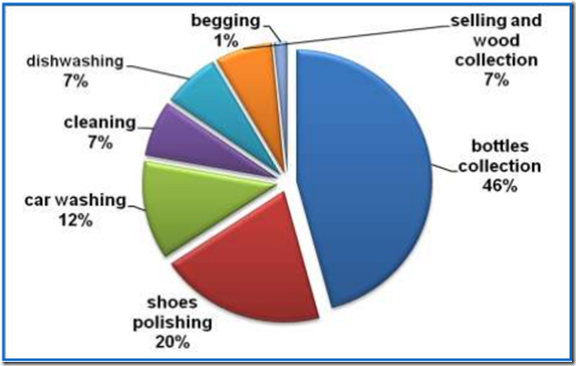
This chart comes from a fascinating new report on Child workers in Juba.

Economic Activities of Children working on the streets in Juba.

image

I’m really torn on whether it is a good idea to give money to these kids or not. They are usually around outside the Ministries washing cars, and polishing shoes at the local cafes. It seems like a classic aid problem of weighing the direct benefit vs the indirect harm. Is the meal today worth more than the disincentive to attend school?

I’ve tried to do a bit of homework (er, googling), and one of the foremost experts on the economics of child labour seems to be Kaushik Basu, previously a professor at Princeton and now Chief Economic Adviser to the Government of India (he has written a book on the subject – see here for the review on Marginal Revolution). Sadly though all I can really find are government policy recommendations, with no suggestions for the concerned individual (although there are some general concerns about potentially perverse impacts of well-meaning trade boycotts at the national level.

Any ideas?

Finally back to that report. It doesn’t tell us how many of their interviewees just work on the streets, and how many live there too. It doesn’t tell us how the questions were worded. It doesn’t have any cross-tabulations. Next time I would recommend paying a visit to the SSCCSE for some statistical advice.

17 June 2010

New Poverty figures for Southern Sudan

The Southern Sudan Centre for Census, Statistics, and Evaluation (SSCCSE – yes its a bit of a tongue-twister, but still probably easier to say and remember than the SSFFAMC), released yesterday the results of the first ever nationally representative household survey in Southern Sudan.

The headline to note is that “poverty” is considerably lower than previously estimated. In 2005 somebody licked their finger and stuck it in the air, and decided that probably about 90% of the population was living below a poverty line of $1 a day. This figure then got quoted and repeated in the opening paragraph of every report written since. Back to the drawing-board guys.

The new poverty line (based on a basic calorific intake plus a bit of non-food consumption) is SDG 73 per month – roughly a dollar a day at official market exchange rates (but a bit less at actual unofficial market exchange rates).

50% of the population falls below this poverty line.

Average consumption is SDG 100 per month.

More to come as soon as I can find an online version I can link to.

And does anyone at SSCCSE want to comment?

15 June 2010

Randomisation done right

Probably the primary criticism of randomised control trials (RCTs) is that although they prove something very well in one context, the findings aren’t necessarily transferable to another context.

Another major criticism is that they tell you what happened but not necessarily how it happened.

To solve both of these problems what you need is theory. There is of course nothing intrinsic to doing an RCT which precludes also using this evidence to test or develop a theory.

Two new papers by leading researchers in this field do just this:

A BREAD Working Paper by Karlan, McConnell, Mullainathan, and Zinman explains why reminders to save are so effective, and a Working Paper by Duflo, Hanna and Ryan explains why financial incentives are effective at getting teachers to turn up.


Getting to the Top of Mind: How Reminders Increase Saving

We develop and test a simple model of limited attention in intertemporal choice … We find support for [the model’s] predictions in three field experiments that randomly assign reminders to new savings account holders.


Incentives Work- Getting Teachers to Come to School

We use a randomized experiment and a structural model to test whether monitoring and financial incentives can reduce teacher absence and increase learning in rural India.

The Campaign for Southern Sudanese Independence begins

image

Some great photos by Pete Muller

14 June 2010

World Cup Fever hits Southern Sudan

Never mind, England. In other World Cup news, my house is now flooded with the sound of vuvuzelas from all of the neighbours’ TV sets, and I am trying to bring some British culture to my Sudanese colleagues in the office with some irresponsible gambling (er, sweepstake, for.. team-building and stuff).

And here is Karuna Herrmann on a recent trip to Wau:

People in developing countries tend to have an impressive grasp of all things football – league and national. Not so my driver in Wau.
A: Tab3an I will watching World Cup!
K: Who do you want to win?
A: ManU!
...K: I’m afraid they didn’t qualify.
A: ManU is very good!
K: Yes, but the World Cup is for national teams.
A: . . .
K: It’s for the teams of countries.
A: . . .
K: ManU is not a country.
A: IS NOT A COUNTRY?!

04 June 2010

Bad News Friday

My nemesis the Stationary Bandit notes that the economy of Botswana shrank last year.

Last year's economic performance was not good.

  • Botswana’s economy contracted by 6.7 percent last year as revenue from diamonds plummeted, Central Bank Governor Linah Moholo said.

This succinctly summarizes the problem for Botswana. Although its growth record for decades has been impressive, it remains too undiversified.  Diamonds and cattle remain large sectors of the economy.  When diamond revenues plummet, the economic consequences are severe.  Add in the HIV/AIDS situation with a contracting economy can quickly turn an African success story into another African Growth Tragedy.

I’m going to get drunk.

03 June 2010

Constraints to medium-sized firm growth

The World Bank’s “Doing Business” reports assess the ease of doing business in different countries, by comparing policies and regulation. It is a fascinating exercise, but one which is based upon an implicit assumption that these rules matter, and that they are binding.

A new NBER working paper by Mary Hallward-Driemeier, Gita Khun-Jush, and Lant Pritchett argues that in Africa, policies and regulations are typically not very well implemented, meaning that deals are more important to firms than rules.

We argue that often firms in Africa do not cope with policy rules, rather they face deals; firm-specific policy actions that can be influenced by firm actions (e.g. bribes) and characteristics (e.g. political connections).  Using Enterprise Survey data we demonstrate huge variability in reported policy actions across firms notionally facing the same policy.   The within-country dispersion in firm-specific policy actions is larger than the cross-national differences in average policy … Finally, we show that the de jure measures such as Doing Business indicators are virtually uncorrelated with ex-post firm-level responses, further evidence that deals rather than rules prevail in Africa.

The constraints reported by 3317 firms in 13 countries are shown in the Figure below. The point being made is that policy uncertainty is much more important than licences or customs clearance, but I am also pretty stunned by the reported importance of electricity.

image

Net-migration bubble map

image

From: Growthology.org

The Guardian to stop printing by 2015?

More on the economics of newspapers:

Peter Kirwan at  wired.co.uk has pieced together some numbers and estimates that the Guardian’s online ad revenues could be enough to entirely funding its reporting and editorial operations by 2015.

[£40m] is the number budgeted for overall digital revenues at GNM [Guardian News & Media] during the year to March 2011.

GNM expects to boost its digital revenues by around 30 percent in the space of a year.

I’ve used a range of more realistic growth rates to estimate how long it might take GNM’s digital operations to earn the £100m required to keep a decent-sized newsroom operating seven days a week.

At 10 percent annualised growth, the target date is 10 years away, in 2020.

At 15 percent, it’s seven years away, in 2017.

At 20 percent, it’s five years away, in 2015.

I need an iPad now.

02 June 2010

The “missing middle”

The failure of microfinance to have a large impact on firm creation and firm growth (Banerjee et al. 2009; Karlan and Zinman 2009; a summary by FT) may be due to its targeting of poor people and small-scale firms. It is medium to large scaled firms that are missing in less developed countries (LDCs) if the firm size distribution is compared to the one from developed countries (Hsieh and Klenow 2009), and that type of firms is probably the driver of economic growth. Governments in LDCs and development assistance agencies, however, have ignored these medium and large scaled firms.

That is Abhijit Banerjee talking at the Annual Bank Conference on Development Economics.

I suppose medium scaled firms just aren’t as sexy as a single female entrepreneur. Perhaps we need a catchy name for support to mid-sized firms. “Middle-finance”? “Medium-finance?” “Meso-finance?” Melody Atil is trying to plug this gap in Southern Sudan by recruiting investors for slightly larger firms.

Then again financing might not even be the main constraint to firm growth…

01 June 2010

The Curious Economics of the Newspaper Business

newspapers typically spend about 15 percent of their revenue on what, to the Internet world, are their only valuable assets: the people who report, analyze, and edit the news. Varian cited a study by the industry analyst Harold Vogel showing that the figure might reach 35 percent if you included all administrative, promotional, and other “brand”-related expenses. But most of the money a typical newspaper spends is for the old-tech physical work of hauling paper around. Buying raw newsprint and using it costs more than the typical newspaper’s entire editorial staff.

The Atlantic